Inka & Niclas are the Winners of the BMW Art Commission 2026
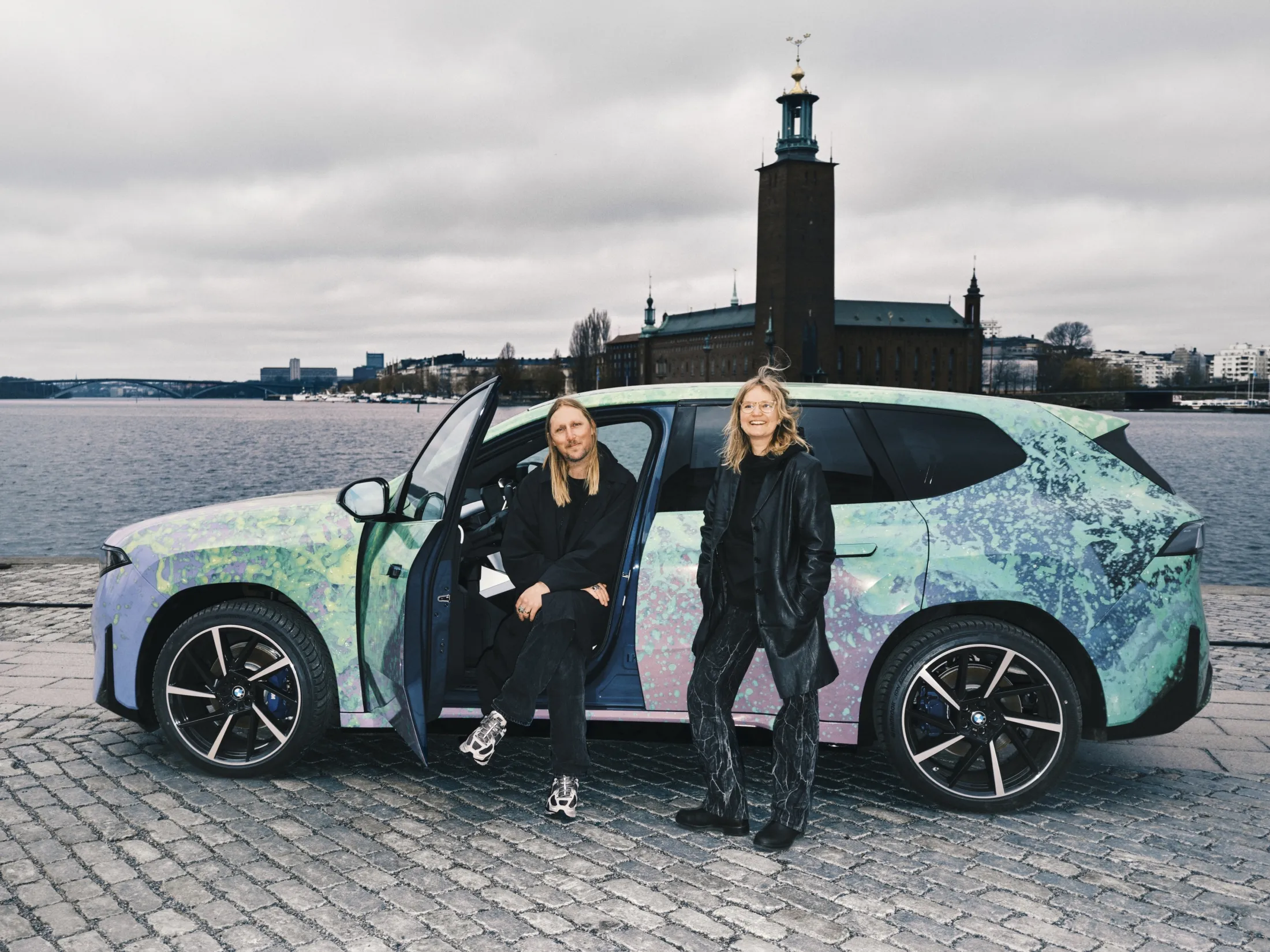
For the fourth consecutive year, Market Art Fair partners with BMW Sweden to present the BMW Art Commission, an initiative celebrating the intersection of contemporary art, innovation and mobility.
For the 2026 edition, the commission is awarded to the artistic duo Inka Lindergård (b. 1985, Finland) and Niclas Lindergård (b. 1984, Sweden). The artists live and work in Stockholm and have collaborated for nearly two decades.
“We met while studying and started working as a duo right after that, so you could actually say we have always worked together. It’s been close to 20 years now, so it certainly feels like always.”
Working as a duo requires its own structure and rhythm. Over time, Inka and Niclas have developed a way of sharing responsibilities while making decisions together, balancing practical tasks with the more intuitive process of developing new work.
“How we divide the work now is quite stereotypically boring: logistics and communication are usually on Inka, and the technical part is on Niclas. Conceptual and aesthetic decisions are on both of us. The moment of actually making new works is kind of a strange thing where we try to carry out a joint idea with two separate brains and, in part, skill sets. We always try to be very attentive to each other, sometimes so much so that Niclas is doing something he thinks Inka wants and the other way around, and it’s actually not what either of us wants. Usually it just works really well though. What we have going for us is energy management. One always has more “go” than the other, and since we are two we can push each other or just take over.”
“One always has more “go” than the other, and since we are two we can push each other or just take over.”
BMW Sweden’s continued collaboration with Market Art Fair reflects a shared commitment to artistic experimentation and technological development. This year’s commission brings anew visual language to the streets of Stockholm, as Inka & Niclas apply their distinctive sculptural-photographic practice to BMW’s fully electric shuttle fleet.
-
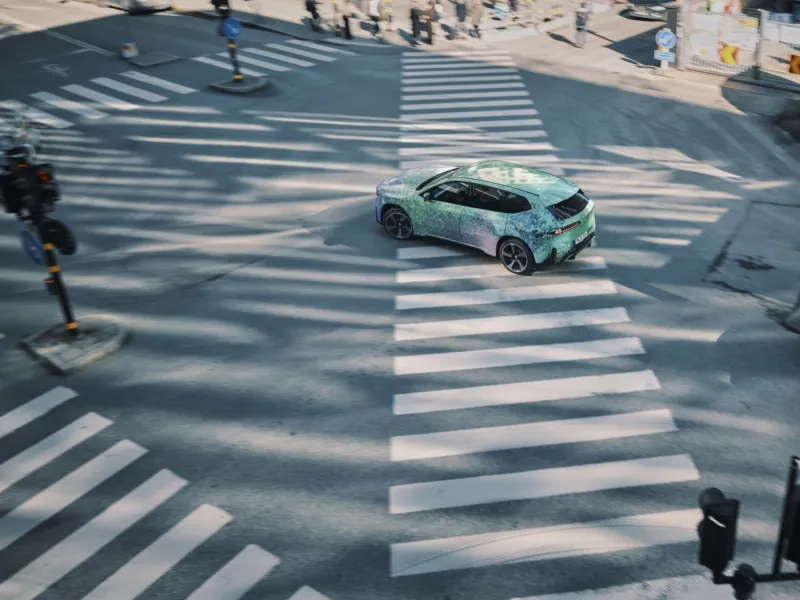
Photo Oskar Omne
For nearly two decades, Inka & Niclas have explored nature through the camera, not as documentation but as a way of examining how ways of seeing are shaped. Working across photography, video, sculpture and installation, they investigate how visual conventions and technology shape our perception of the natural world. Their work often moves between image and object, making the car a natural extension of their sculptural approach to photography.
“Niclas is by far the one who is more excited about this. His first car was a BMW 318i from 1988, which he used to spend hours drifting around snowy parking lots in the small Swedish town of Sandviken when he was 18 (still today the most stylish and fun car he ever owned). Inka couldn’t care less about cars.”
The connection is not entirely unexpected. In their sculptural work, Inka & Niclas use techniques that originate in car customisation and industrial surface treatment.
“It’s good and healthy to screw around and mess with photography. Actually the whole thing started with cars. We came across this car guy on the internet dipping his rims in aflame pattern and realized that someone, somewhere, had printed those flames onto whatever was floating there. The flame pattern was a print, which meant that since we know printing, in theory we should be able to do the same. We started out with natural objects like branches and stones but moved on to sculpting somewhat amorphous forms ourselves. The process is brutally difficult but also fantastic. Nature becomes a digital file printed by a machine, and then becomes matter with weight again through the very analog, muscle-straining process of shaping, sanding, painting and dipping. The result has to do with so many tiny variables: ambient temperature, seconds, humidity and the dance-like ritual motion when the object goes into the water. There’s something poetic about being able to dip objects into photographs. The image warps, stretches and eventually breaks apart. What’s left is something perfectly sharp, vivid and readable, yet cryptic and strange.”
-
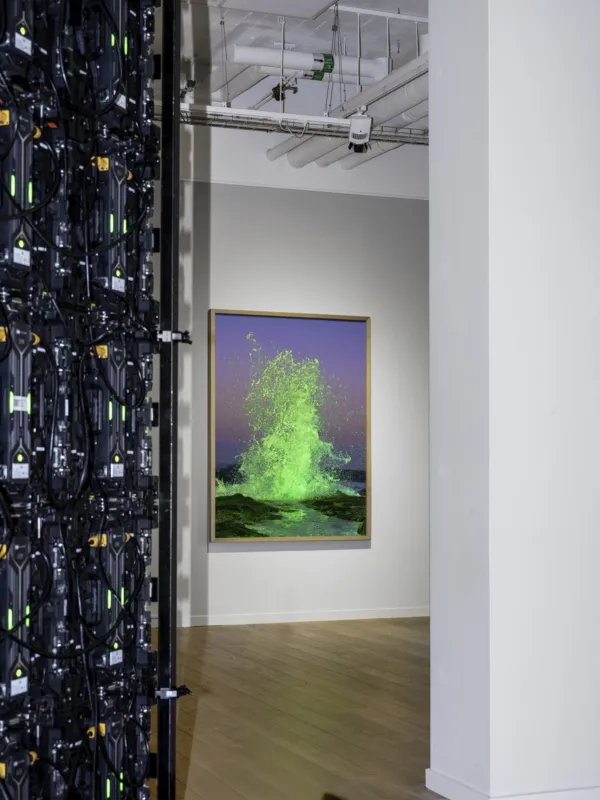
'Ultra Instant'. Courtesy of Lidkoping Konsthall -
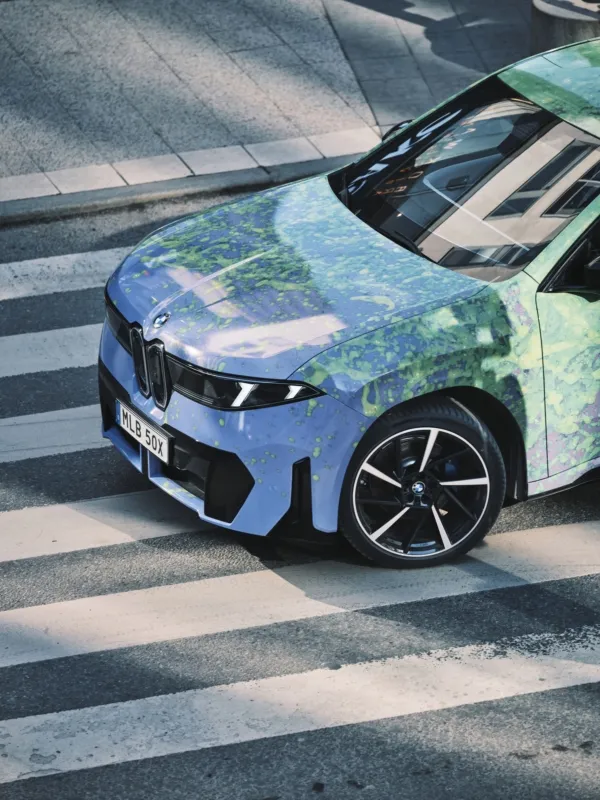
Photo Oskar Omne
“We like to repurpose photographs and are interested in what happens to an image when it is stretched and distorted, what remains when it becomes about details rather than the whole. When we dip our sculptures, it’s like reframing the photograph again. What is up or down, or where the horizon is, is no longer important. We recently made new sculptures and approached the car in the same way. We laid out the photograph, imagined holding the car in our hands instead of the object, and asked ourselves where we would dip it. Dipping a car feels like a full circle in a way. Many of the techniques we use come from car culture, and now we’re working from within that logic.”
Motifs and locations play a central role in their work. Moving between close observation and distant horizons, their photographs explore how landscapes are framed and experienced. Locations are often remote and carefully chosen, and the search for them usually falls to the practical side of the collaboration.
“That would definitely be Inka. But it’s a really hard question to answer. If we knew how to find where to go and what to do our life would be so much easier. Sometimes we have a clear idea of what we are after and what we want to do, and in that case it’s just a matter of finding a good setting and taking a chance and hoping for the best. But quite often we just need or want to produce new works and have no idea what those works are going to be, then planning gets really tricky. If that’s the case we have to rely on the fact that we have gone away before, and usually we come back with something new. In those cases islands work very well since they often have very diverse settings in a limited geographical space. One thing is all these worn-out names, islands that have been charter destinations for 60 years. There’s a reason they became famous in the first place. Most of them have a north side or a coast away from the all-inclusive hotels where you can find so many interesting settings. We usually go where the surfers go.”
-
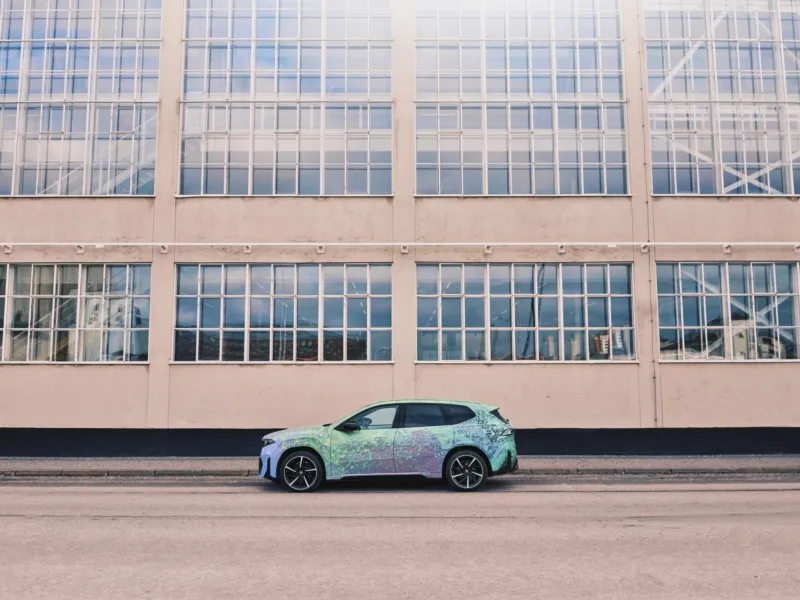
Photo Oskar Omne
Digital research also plays an important role in this process, allowing the artists to explore potential locations and observe how landscapes are already framed and circulated through images online.
“Google Maps, geotags and such are useful for logistics, checking Street View to see if there’s a reasonable entrance to a spot and so on. A lot of what we do has to do with the mechanics between us as humans, nature and the camera. With how photographs influence our expectations of nature, and why and how we portray and consume it. Therefore other people’s photographs are a big source of inspiration for us. You can right away see how a certain location or setting is “supposed” to be photographed, angles, time of day, and from what exact position. That kind of information is both conceptually interesting and also really practical.”
This openness to experimentation is central to the duo’s work. Changes in material, scale and context continuously shift how the images are perceived.
“Of course it does, context is everything. In this case it’s a mix of several things. It’s an initiated art audience because of the connection to the fair, but the cars will also move around the city, maybe sometimes park next to each other and so on. It’s also a commission and it’s impossible not to factor in all the connotations that the product, a car, brings. People are used to seeing bold colors and exaggerated finishes on them. That inspired us to up the volume. We need to push our work in different directions to see what happens, that has always been the way we move forward.”
-
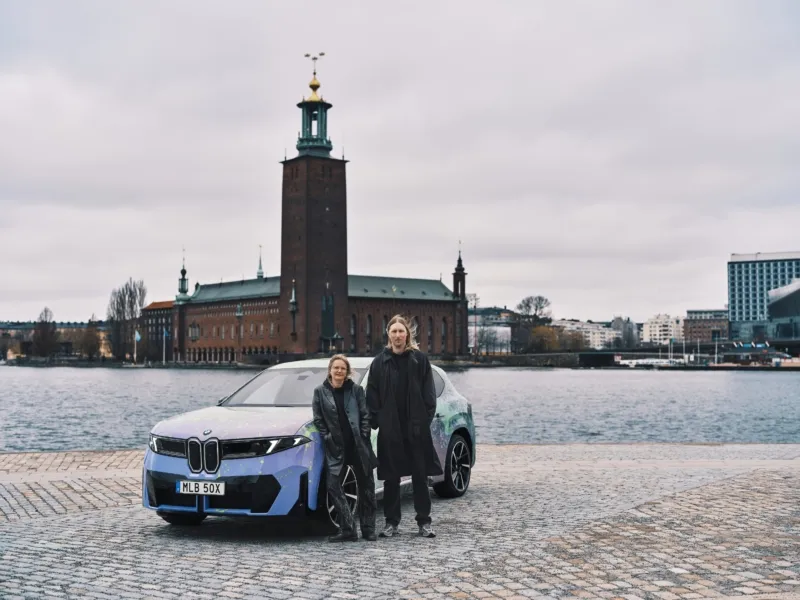
Photo Oskar Omne
Three BMW models – X5, i7 and iX3 – are wrapped in the duo’s work and will operate throughout the fair, transporting guests across the city. One vehicle will be displayed outside the fair entrance, extending the artwork into public space and making it accessible beyond the fair’s walls. Another car will function as a “conversation car,” hosting interviews by The Art Bystander with artists and guests from the art world.
-
Want to Partner with Us?
BMW Art Commission

Collaborations
Artist Gregor Hildebrandt Wins BMW Art Commission 2025
For the third consecutive year, Market Art Fair is thrilled to continue the collaboration with BMW. This year, the german artist Gregor Hildebrandt has…

Collaborations
Artist Katrin Westman wins BMW Art Commission 2024
Westman Stripes BMW’s VIP–cars for 2024’s edition of Market Art Fair For the third consecutive year, Market Art Fair partnered with BMW, and for…

Collaborations
BMW Art Commission at Market Art Fair 2023
For the 2023 fair, our partner BMW launched a new initiative in line with BMW Group’s commitment to promoting art and innovation. The BMW…