Kim Andreas Roland Berger – A Young Norwegian Artist Bringing Nordic Light and Nature into the World
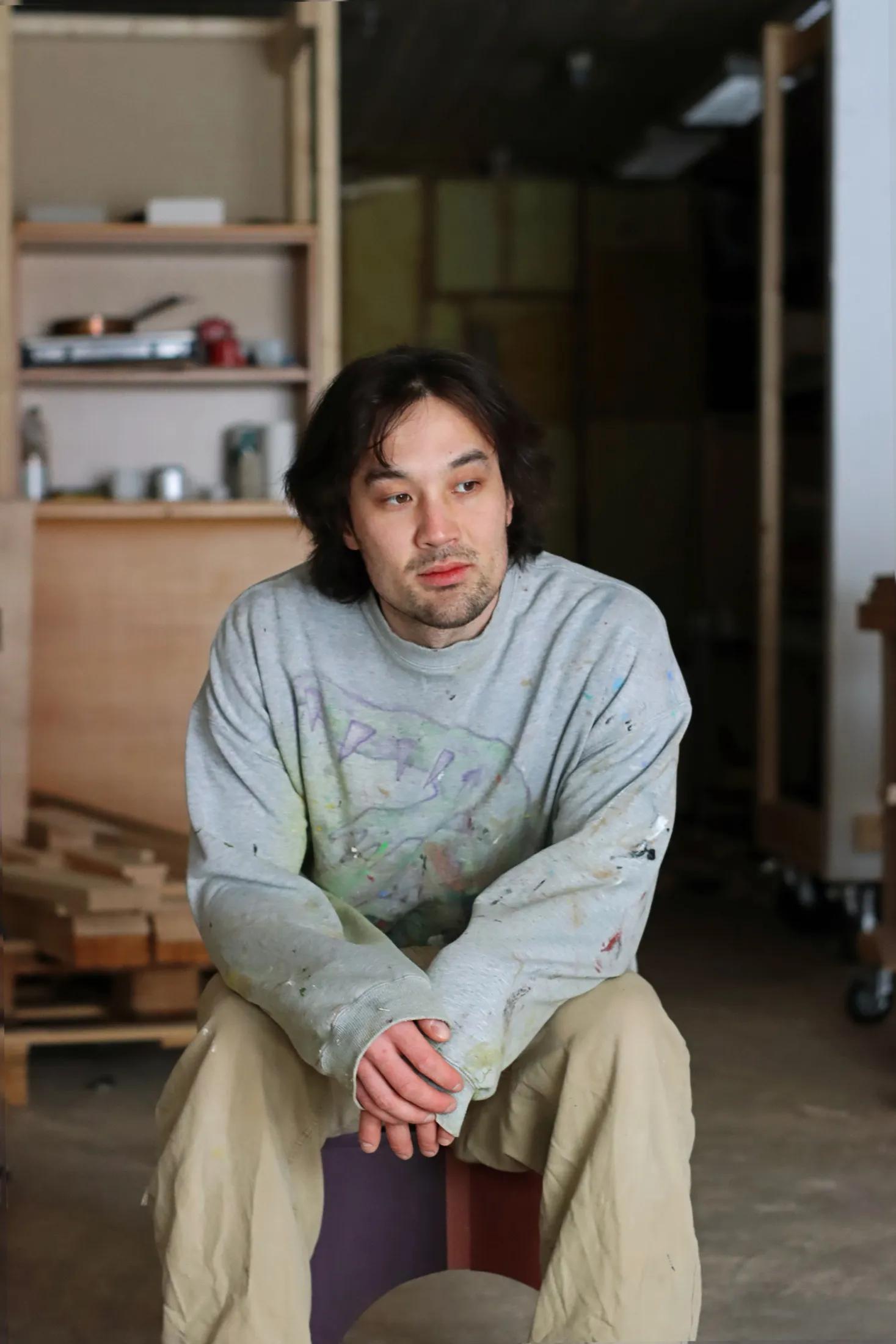
Each year, the Fredrik Roos Foundation awards a grant of SEK 1 million, together with an exhibition at Artipelag. This year’s recipient is Kim Andreas Roland Berger.
Roland Berger mainly paints in his studio, working with the particular light of the Nordic region and an interest in the materiality of colour. His work often returns to uncontaminated settings, such as the farm that recurs in both his work and memory, and which has become a point of departure for his recent practice.
Ahead of the opening of his exhibition ‘Accumulated Stacks’, we spoke with Roland Berger about Nordicness, the family farm where he has his studio, and the environments that shape his work.
“If I were to describe my work, I would say that I work in series across drawing, painting and sculpture, driven by a curiosity about materials and pigments in different forms. For me, colour is a subject in itself, almost a narrative.”
“I’m interested in placing visual and tactile contrasts against each other. I use art history as a material, but it’s not necessary to understand those references in order to experience the work.It’s important to me that the work can be encountered directly, without prior knowledge,” he continues.
The motivation given by the Fredrik Roos Foundation describes Roland Berger as an artist whose work begins in a Nordic Romantic tradition that still lingers on the farm where his studio is based. His practice brings together the emotional intensity associated with Edvard Munch and the more experimental language found in Jasper Johns’ Foirades/Fizzles. The result is a form of painting shaped through interaction and tension, which Roland Berger has compared to the movement within a bucket of crabs.
The motivation given by the Fredrik Roos Foundation describes Roland Berger as an artist whose work begins in a Nordic Romantic tradition that still lingers on the farm where his studio is based. His practice brings together the emotional intensity associated with Edvard Munch and the more experimental language found in Jasper Johns’ Foirades/Fizzles. The result is a form of painting shaped through interaction and tension, which Roland Berger has compared to the movement within a bucket of crabs.
-
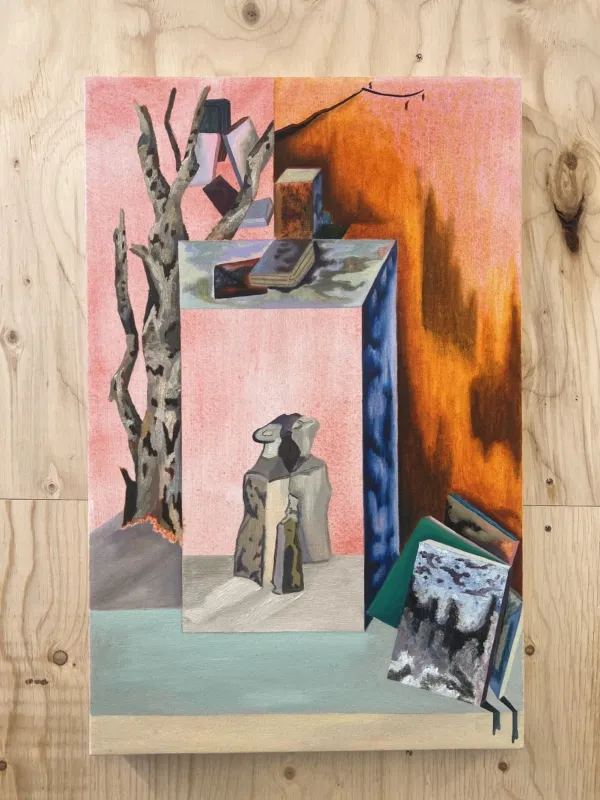
Kim Andreas Roland Berger, 'Gliched Stacks', (2026) -
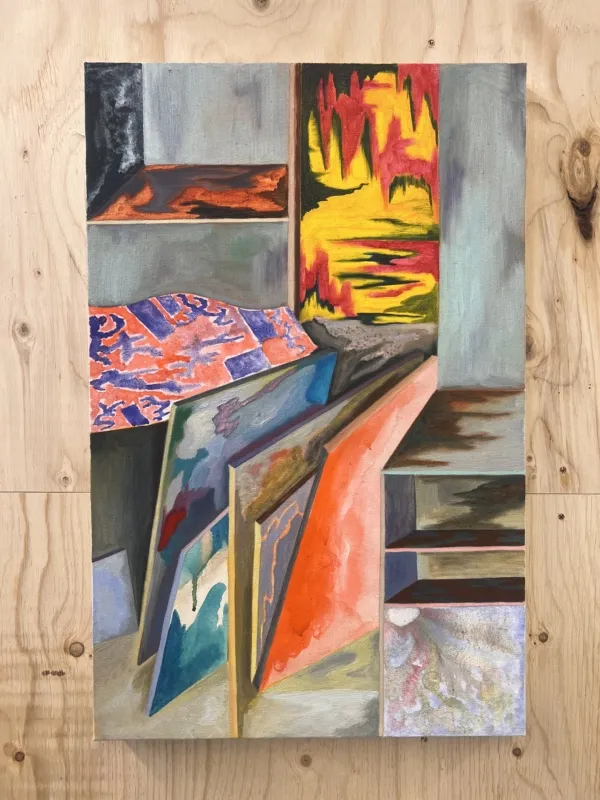
Kim Andreas Roland Berger, 'Studio Stacks', (2026)
The farm in question is his family’s farm in Frogn, where he lives and works.
“It’s a farm built by my great-grandfather and grandfather. It operated as a chicken and vegetable farm, but today we don’t have animals or grow vegetables. I have been painting and making sculptures there for almost a decade. Where there once were chickens, there are now stacks of paintings and piles of wood and sculptures.”
“I’ve had my studio there for many years, making sculptures from old wood I find in the barn and paintings inspired by the surroundings. It’s a space where time stands still, and where thoughts and ideas are given the time and quiet they need to develop. On the farm, there is very little light pollution. In winter, it becomes completely dark. When there is snow and a clear sky, the moon lights up the landscape enough that you can almost see in the dark.”
He continues:
“It’s about how the gradual changing of the seasons affects colour and the visual information in your surroundings. Cold winter days at the farm, with an intense sunset followed by snow reflecting the moonlight, turn the landscape into something almost unrecognisable. There’s just enough light to see the contours of the forest, but not enough to see the trees. Painting during dark winter nights has given me unique experiences in the studio, where everything turns black and white and all colour disappears. I only see in greyscale. Through my upbringing, I’ve learned a lot from working outdoors with my grandfather, knowledge passed down from his father to him, and from him to me.”
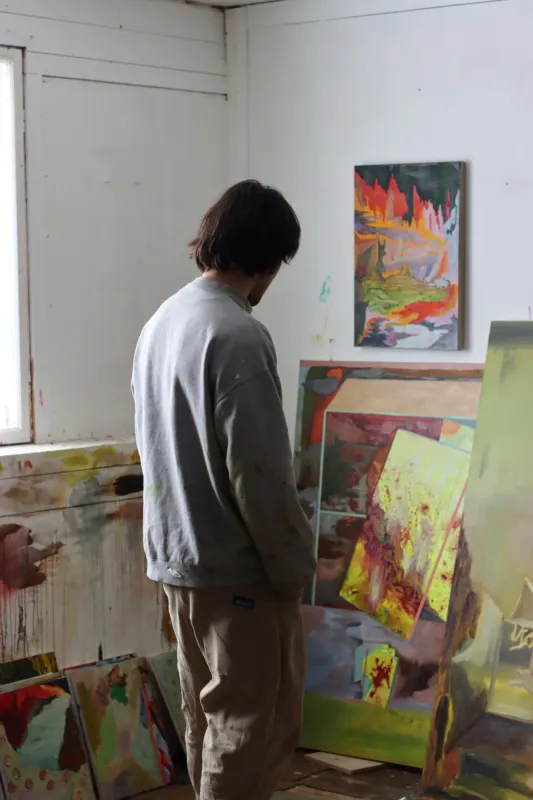
“My studio has the same temperature as outside, as it needs to be ventilated to remove fumes from the oil paint. In winter, I can work in temperatures down to –15°C. It affects the mind. I become more focused. There’s less time to linger, and the execution becomes sharper. My hands are the challenge, so I have to wear large mittens. It made me think of a painter as a crab, moving sideways in front of the canvas, hands like claws gripping the brush.”
Roland Berger has also pointed to artists such as Karin Mamma Andersson as a source of inspiration, sharing an interest in immediate surroundings and in the histories embedded in Nordic landscapes and interiors.
“Watching a sunset without light pollution is the closest I come to a magical experience. I’m not trying to replicate it exactly, but rather to capture a feeling that holds my memories. Throughout art history, light has been depicted in many ways through the ‘window’ that a painting can represent.”
Many of his works depict quiet rural or domestic settings shaped by life on the farm.
“When I work in Oslo, everything feels more chaotic. Moving through the city exposes you to a constant flow of visual information, making it harder to filter what matters. My process often starts with drawings I make just after waking up. In that state, I feel calm and unfiltered. My mind returns to familiar places, often the farm, my studio, paintings I’ve made, and paintings I want to make.”
-
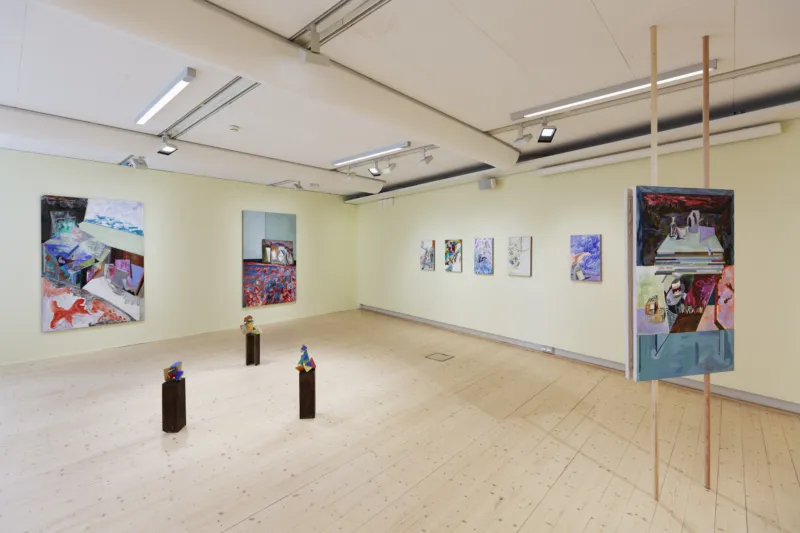
Photo Paulina Simon
The Fredrik Roos Grant is awarded to younger Nordic artists working primarily in painting and sculpture. The recipient is expected to take risks, trust their own direction, and develop a distinct artistic language.
Fredrik Roos (1951–1991) founded Rooseum – Centre for Contemporary Art in 1988, where international exhibitions were shown alongside his collection of Nordic contemporary art. Today, the grant is awarded annually to support the continued development of emerging artists.
For Roland Berger, the recognition still feels immediate.
“I’m still adjusting to the idea of having received the Fredrik Roos Grant. There are small daily reminders that make me very happy. Being able to show work outside Norway is something I really look forward to. It makes me think differently and gives me motivation and new ideas for the future.”
“I’m still adjusting to the idea of having received the Fredrik Roos Grant. There are small daily reminders that make me very happy.”
“I want to continue developing my interest in different materials, working more with egg tempera and exploring ways of applying paint that move between figurative and abstract language. During my exchange at the art academy in Budapest, I was introduced to stone carving and printmaking, which I would like to continue alongside my current work. I’m interested in how different materials and scales can interact, and in seeing how the practice develops over time.”
‘Accumulated Stacks’ is on view at Artipelag from 24 April to 14 May.